
RESEARCH TOPICS GUIDE
How to choose, develop and finalise a strong research topic.
Choosing a research topic is one of the most important decisions in an academic research project. A strong topic should be interesting, focused, feasible and capable of supporting a meaningful investigation.
RESEARCH FOUNDATIONS
A research topic is the starting point of the research journey
A research topic provides the initial direction for an academic investigation. It identifies the broad subject or phenomenon that a researcher wants to understand, analyse or investigate.
However, a broad topic is rarely enough for a dissertation, thesis or research paper. The topic normally needs to be explored, narrowed and refined before it can become a clear research problem, research question and set of objectives.
STEP-BY-STEP WORKFLOW
From a broad idea to a final research topic
Selecting a research topic is usually a process rather than a single decision. Researchers can move from a broad area of interest through preliminary research, feasibility assessment, research questions and proposal development before finalising the topic.
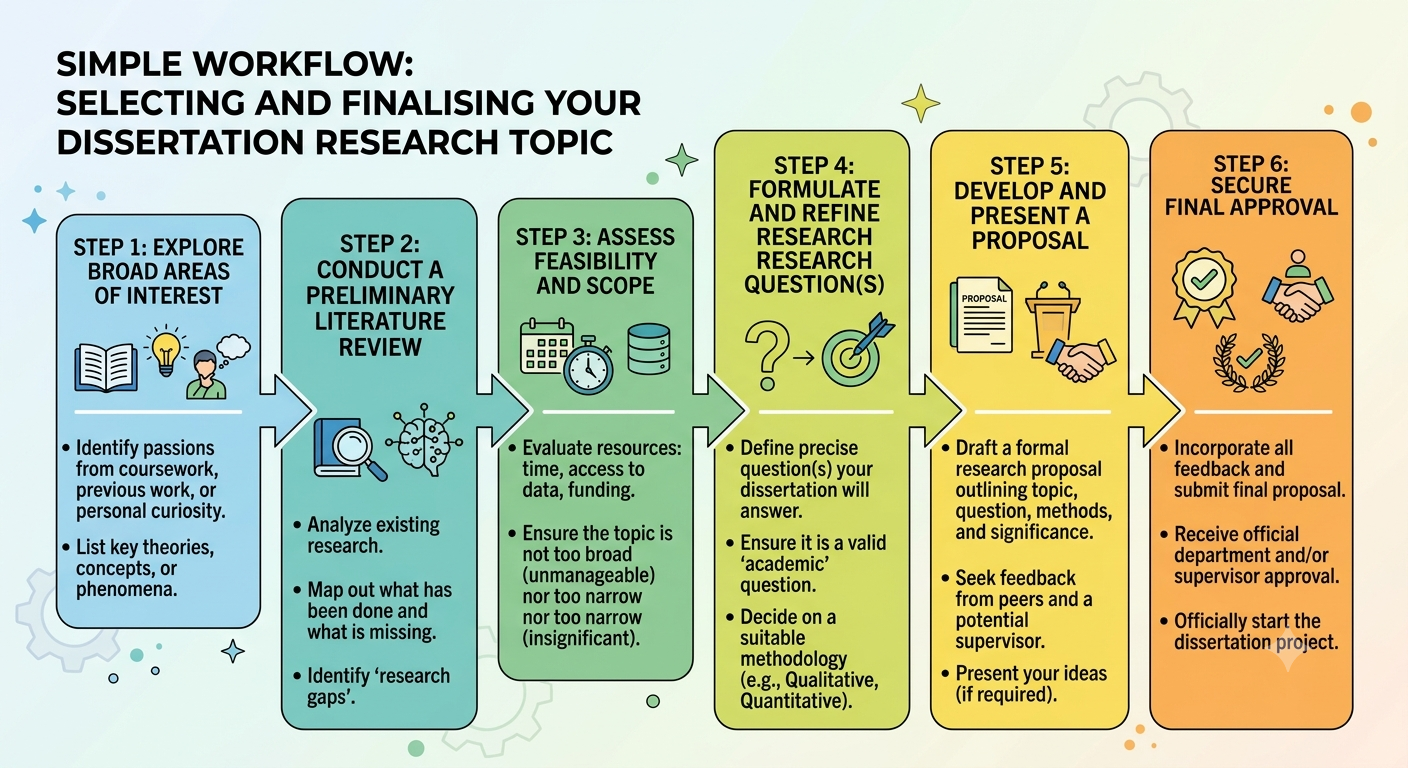
A practical workflow for selecting and finalising a dissertation research topic.
STEP 1
Start with broad areas of interest
The first stage is to identify areas that genuinely interest you. Your starting point may come from coursework, previous academic work, professional experience, current debates, personal curiosity or a subject that you would like to understand in greater depth.
At this stage, the goal is not necessarily to create the final dissertation title. Instead, identify several possible areas and consider which ones have enough academic substance to investigate.
Subjects you enjoyed during your coursework
Problems encountered in professional practice
Current academic or industry debates
Questions raised by previous research
STEP 2
Conduct a preliminary literature review
Once you have identified potential areas, examine the existing academic literature. This preliminary review helps you understand what has already been studied and where uncertainty, disagreement or gaps may exist.
The purpose at this stage is not to complete the literature review for your final paper. Instead, it helps you determine whether your initial idea has enough academic material and whether there is a useful direction for further investigation.
Questions to ask during the preliminary review
- • What has already been studied?
- • Which theories or concepts are commonly used?
- • Are researchers reaching different conclusions?
- • What limitations have previous studies identified?
- • Is there a clear area that could benefit from further research?
STEP 3
Assess feasibility, scope and resources
An interesting topic is not automatically a practical research topic. Before finalising an idea, researchers need to consider whether the project can realistically be completed within the available time, resources and academic requirements.
Time
Can the research realistically be completed within the available academic timeframe?
Data
Will you be able to obtain the information, participants or datasets required?
Access
Do you have practical access to the organisations, people, literature or resources involved?
Scope
Is the topic focused enough to investigate properly without becoming unmanageable?
STEP 4
Refine the topic into research questions
A strong research topic should eventually lead to questions that can actually be investigated. Refining the topic therefore involves moving from a broad subject toward a specific issue, population, context, relationship or phenomenon.
The research questions provide a more precise expression of what the study is attempting to understand or answer.
Read the Research Questions Guide →STEP 5
Develop and present a research proposal
Once the topic has been refined, the next stage is to develop the research proposal. Depending on the institution and programme, this may explain the research problem, questions, objectives, literature background, methodology and significance of the study.
Feedback from an academic supervisor or department can help identify weaknesses in the proposed scope and provide an opportunity to refine the project before formal approval.
A strong proposal should make the research direction clear
The topic, research problem, questions, objectives and proposed methodology should work together rather than appearing as unrelated sections.
STEP 6
Secure final approval
The final stage is to incorporate feedback and obtain the required academic approval. Depending on the programme, this may involve approval from a supervisor, department, research committee or another academic authority.
Once the topic and proposal have been approved, the researcher can formally begin the dissertation, thesis or research project.
EVALUATION
What makes a strong research topic?
Before committing to a topic, evaluate it against several practical and academic considerations.
Clear
The topic should communicate the main subject of investigation without unnecessary ambiguity.
Focused
A manageable topic is usually better than an extremely broad topic that cannot be investigated in sufficient depth.
Researchable
There should be enough academic literature, evidence or data to support a meaningful investigation.
Feasible
The project should be realistic given the available time, resources, access and academic requirements.
Relevant
The research should address a meaningful academic, professional, theoretical or practical issue.
Capable of producing questions
The topic should provide a foundation from which focused research questions and objectives can be developed.
COMMON MISTAKES
Problems to avoid when selecting a topic
Choosing a topic that is so broad that it cannot be investigated in sufficient depth.
Selecting a topic simply because it sounds interesting without checking the available literature or evidence.
Choosing a subject where access to participants, data or other essential resources is unrealistic.
Ignoring the academic requirements or scope of the dissertation or research programme.
Finalising a topic before considering whether meaningful research questions can be developed.
CONTINUE YOUR RESEARCH JOURNEY
Related research guides
Once you have selected a research topic, these guides can help you develop the next stages of your research project.
Research Problems Guide
Understand how a broad area of interest can be developed into a focused research problem and meaningful research gap.
Explore guide →
Research Questions Guide
Learn how to turn a research topic and problem into focused research questions that guide the study.
Explore guide →
Research Methodology Guide
Explore how qualitative, quantitative and mixed-method approaches influence research planning and topic selection.
Explore guide →
Research Approach Guide
Understand how different research approaches can shape the way a research topic is investigated.
Explore guide →
Need help developing your research project?
Explore My Assignment Buddies for professional academic and technical assistance.
Explore Our Services